
Toyota to Build Range‑Extender EVs for China — 400,000 Units Targeted by 2028
Toyota will start producing range‑extender EVs for China in April 2027, targeting 200,000 units that year and 400,000 in 2028. Initial models are expected to be drawn from the bZ series.
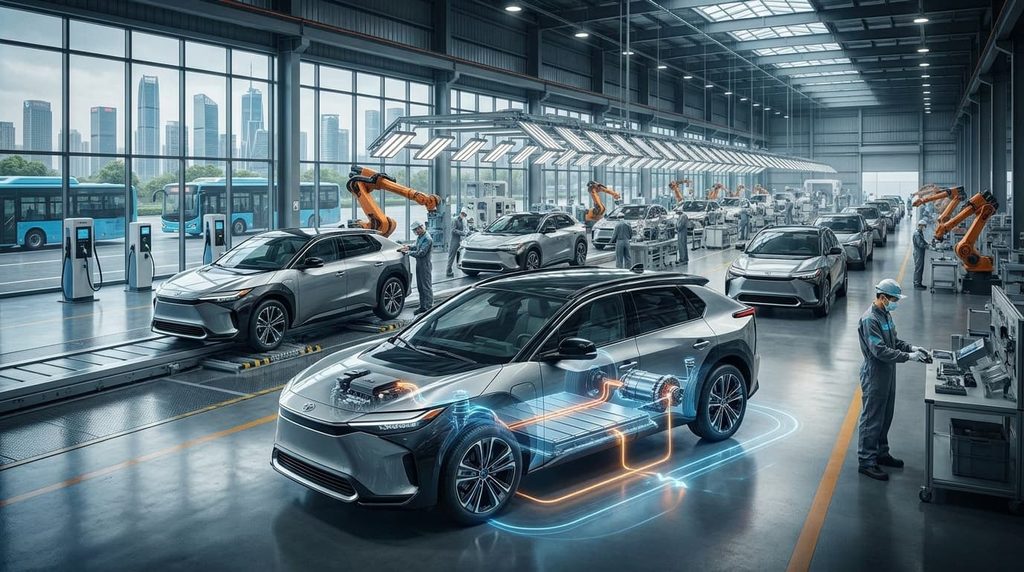
Toyota will begin manufacturing range‑extender electric vehicles (EREVs) for the Chinese market in April 2027, with plans to quickly scale output to 400,000 units a year by 2028, according to reports. The move marks a notable shift for the world’s largest automaker, which has long favoured hybrids over all‑out battery EVs.
Why China and what is an EREV?
Chinese consumers and regulators are showing growing interest in EREVs as a middle ground between pure battery EVs and traditional hybrids: an EREV is driven by an electric motor but carries a small gasoline engine that acts only as a generator to recharge the battery and extend range. That arrangement reduces reliance on charging infrastructure and can deliver very long driving ranges, sometimes cited as exceeding roughly 1,000 km (620 miles).
Nikkei Asia first reported Toyota’s plans. The company intends the initial models to be China‑specific to respond to local demand patterns and pricing dynamics, rather than launching the technology globally immediately.
Production targets, models and scale
Toyota aims to produce about 200,000 EREVs in 2027, then double that output to roughly 400,000 in 2028. To put that in context, Toyota sold around 200,000 battery EVs, 180,000 plug‑in hybrids (PHEVs) and 4.433 million self‑charging hybrids (HEVs) worldwide in 2025.
Details on specific EREV models have not been released, but Toyota already offers several bZ‑series EVs in China that could receive range‑extender variants. Candidates include:
- bZ3 and bZ7 sedans
- bZ3X SUV
- bZ4X crossover
- bZ5 fastback crossover
The bZ3X is singled out as a likely option because its GAC Aion V sister model is already available with a 1.5‑litre engine used in an EREV configuration.
Whether Toyota will offer EREVs outside China remains unclear. The company’s hybrid models continue to sell strongly worldwide, so a global push for range‑extender variants does not appear to be an immediate priority.