
Google, Meta and Isomorphic Labs Back Zuckerberg‑Funded Biohub with $300M to Build an AI ‘Virtual Cell’
Google DeepMind, Meta and Isomorphic Labs are investing $300 million in the Chan‑Zuckerberg Biohub to build AI datasets and a predictive "virtual cell," part of a $1.8 billion initiative supported by major federal contributions.
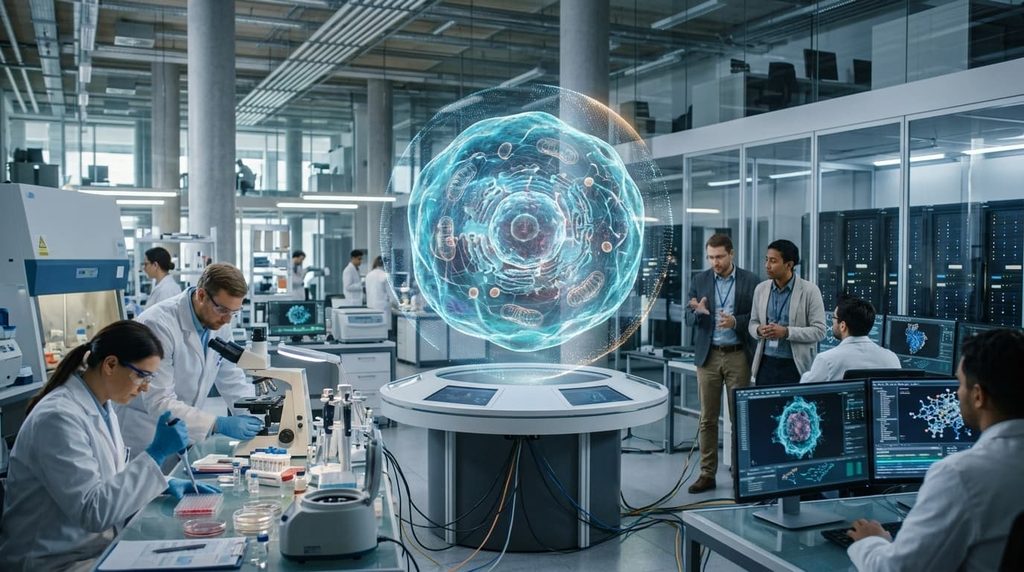
Major tech and biotech players are supplying fresh capital to a high‑ambition scientific project that aims to let researchers run biology in silico. Google DeepMind, Meta, and AI drug discovery startup Isomorphic Labs are jointly investing $300 million into the Chan‑Zuckerberg Biohub to accelerate creation of large AI datasets and simulation tools researchers can use to study cells digitally.
The funding is nested inside a broader $1.8 billion initiative intended to produce interoperable datasets, repositories, and models that let scientists “ask, predict, and answer biological questions digitally,” according to the project announcement. The Department of Energy has pledged more than $500 million over the next five years to the effort, while the National Institutes of Health will contribute existing datasets and knowledge bases drawn from prior federal investments exceeding $500 million.
What the Biohub project aims to do
Founded in 2016 by Mark Zuckerberg and Priscilla Chan, the Chan‑Zuckerberg Biohub seeks to build a so‑called “virtual cell” — a predictive, computational model of cellular biology that can be used for simulation and hypothesis testing. The organization says such an accurate model could speed discovery by enabling many experiments to be run digitally before being validated in the lab.
Alex Rives, Biohub’s head of science, summarized the ambition succinctly: “An accurate predictive model of biology could dramatically accelerate scientific discovery by enabling scientists to perform experiments digitally.” The partners expect coordinated, large‑scale data generation and sharing at national and international levels will be necessary to make the virtual cell practical.
Project backers characterize the investment as a step toward new ways of preventing and managing disease through advanced computational biology rather than a short‑term product push. The combination of private capital from DeepMind, Meta, and Isomorphic Labs with substantial federal contributions is intended to create shared infrastructure — datasets, models, and repositories — that multiple research groups can use.
How quickly the virtual cell concept matures will depend on data standardization, model validation, and sustained collaboration between technology firms, academic labs, and government agencies. For now, the $300 million infusion marks a significant alignment of AI talent and public science resources behind an ambitious effort to transform how biological research is conducted.