
6G spectrum sharing raises testing complexity
Experts at the 6G Forum say spectrum sharing will be central to 6G and that MRSS plus new radio features could multiply testing requirements, raising costs and timelines.
Industry and U.S. officials at RCR Wireless News’ 6G Forum warned that 6G spectrum sharing will be essential as exclusive bands grow scarce — and that sharing plus new radio features will dramatically expand device testing needs.
6G spectrum sharing: MRSS and testing
Panelists said finding contiguous exclusive spectrum for future wireless broadband is increasingly difficult, pushing sharing into the core of 6G planning. Derek Khlopin of the NTIA described the U.S. effort as substantial and unprecedented: “The current spectrum pipeline is not only significant, it’s really unprecedented.” He said NTIA is coordinating federal spectrum studies and looking at international harmonization through the ITU.
AT&T Labs’ Milap Majmundar highlighted multi-RAT spectrum sharing (MRSS) as a path to smoother migration from 5G to 6G. He noted that 3GPP has agreed to limit downlink control-channel overhead for shared control resources to under 3.5%, which he said makes MRSS inherently more efficient than the 4G/5G dynamic spectrum sharing approach. Majmundar also raised the possibility that some capable 5G radios could be upgraded to support 6G interfaces via software, while acknowledging that advanced 6G features will still require new hardware in many cases.
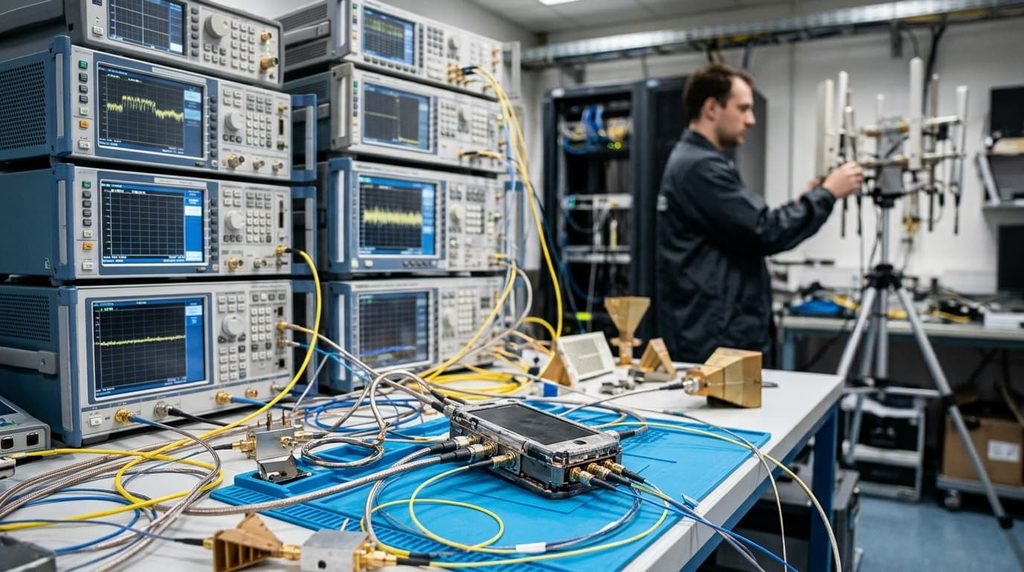
Khushboo Kalyani of LitePoint warned that these new bands, sharing mechanisms and modulation schemes will multiply the RF test matrix. Rather than the roughly linear increase that came with each new band in prior generations, she said 6G is likely to create a combinatorial explosion of test scenarios — driving up development time unless manufacturers focus on practical, prioritized test sets.
Why It Matters
Spectrum sharing and MRSS affect operators, device makers and regulators. For operators, more sharing eases pressure to clear large swathes of spectrum but demands coordination on control channels and coexistence rules. For device manufacturers, the larger test matrix means higher development costs and longer validation cycles that could slow new device rollouts or raise prices. Regulators face trade-offs between clearing federal users, maintaining static exclusion zones and enabling indefinite sharing arrangements, choices the NTIA said will be guided by spectrum studies and transition plans.
For readers tracking Pakistan’s digital future, these developments intersect with local industry and policy moves. National carriers and equipment vendors will need to plan for shared-spectrum use and longer device certification processes as 6G standards and bands evolve. For context on Pakistan’s tech trajectory and telecom companies, see coverage of Pakistan digital transformation at Global AI Summit 2026 and recent operator results such as PTCL Group results: 62% revenue jump in nine months.
Background
Historically, the mobile industry sought exclusive spectrum blocks for each major technology generation. Panelists at the forum said that trend is shifting: growing bandwidth demands, localized 6G deployments and more application-specific uses make exclusive assignments less realistic, increasing interest in sharing between applications and across mobile generations.
The RCR forum discussion shows regulators, standards bodies and industry are already grappling with the technical and policy implications — from MRSS and possible software upgrades of capable radios to the practical burden of validating countless sharing and modulation combinations.
Sources: News Source