
Verizon and Samsung deploy AI-native ISAC crowd sensing on vRAN at Dallas event
Verizon and Samsung demonstrated AI-native ISAC sensing on vRAN at a Dallas event, turning ambient radio signals into real-time crowd heatmaps without cameras and expanding 6G forum partnerships.
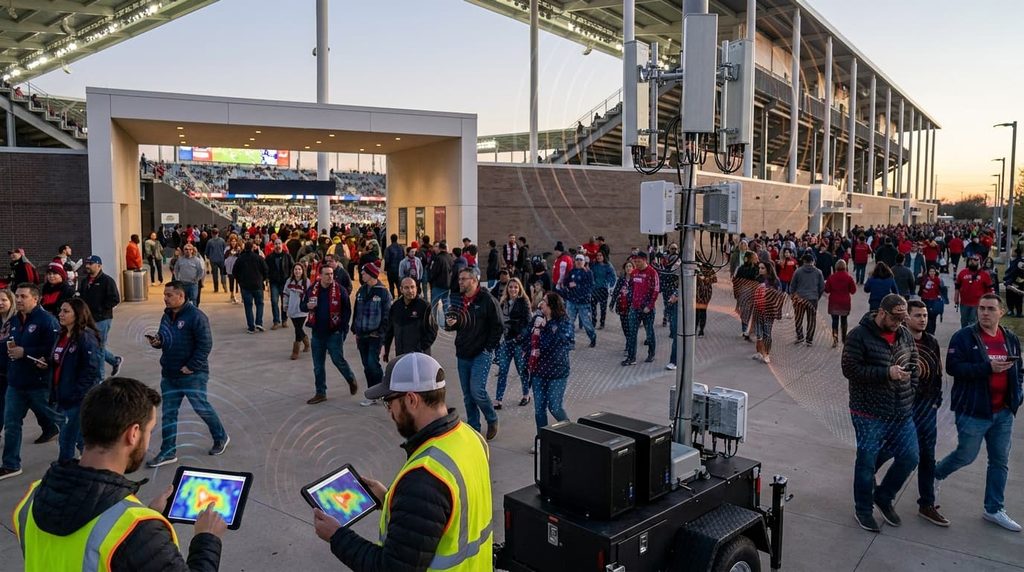
Verizon and Samsung have shown that radio networks can act as large-scale sensors, using AI-native Integrated Sensing and Communication (ISAC) on a virtualised RAN to map crowd movement without installing cameras or dedicated radar. The live demonstration at a major international soccer celebration in Dallas converted routine wireless transmissions into real-time environmental intelligence for event operators.
How the trial worked
Engineers ran an ISAC application on Samsung’s Network in a Server appliance, which consolidates radio functions and accelerated compute in a single unit. Six localised Samsung Galaxy smartphones provided the raw radio signals while a radio unit mounted on a Verizon Cell-On-Wheels used a 40MHz block of Citizens Broadband Radio Service (CBRS) spectrum to track channel variations across the venue.
Edge processors translated changes in the radio environment into heatmaps shown on tablets and handsets, enabling staff to monitor foot traffic, control entry gates and spot bottlenecks without supplementary optical equipment. The workload ran entirely on virtualised RAN software and a virtual core hosted on the on-site appliance.
Related tests and ecosystem work
The Dallas ISAC trial ran alongside other demonstrations and an expansion of Verizon’s 6G Innovation Forum. Nine organisations—Amazon Web Services, Cisco, Intel, Keysight Technologies, MediaTek, NVIDIA, Palo Alto Networks, Rohde & Schwarz and VIAVI Solutions—joined founding members Ericsson, Nokia, Meta, Qualcomm Technologies and Samsung to align edge compute and radio architectures ahead of formal standards work.
Separately, Qualcomm teams in San Diego ran a concurrent test using 100–400MHz of millimetre-wave spectrum across four synchronised transmission and reception points to autonomously track a drone and ground vehicles while preserving uninterrupted 5G Standalone data service to a mobile user.
Software teams are also exploring user-facing integrations. In a stadium prototype, Meta AI smart glasses were linked to the Verizon Edge Network and an on-site NVIDIA DGX Spark unit running a locally tuned small language model, delivering spoken sports telemetry and predictive analytics sourced from SportsDataIO directly to users without a smartphone.
Verizon says these experiments are shaping requirements for distributed edge compute and radio access as untethered wearables and environmental sensing are expected to create balanced uplink and downlink demands. Field work will continue at Verizon’s dedicated 6G Lab in Los Angeles, which will serve as a proving ground during the 2028 Summer Olympic Games.
The demonstrations underscore a broader industry push to embed AI and sensing into network infrastructure, blending communications and environmental awareness to enable new operational and consumer services.